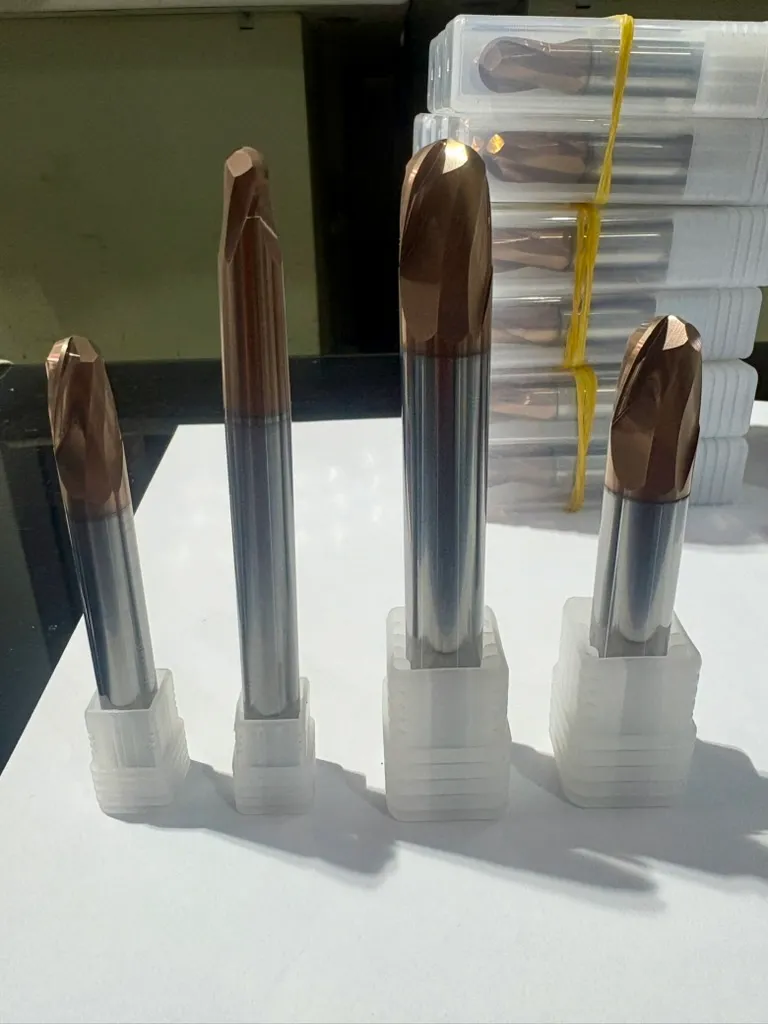
Source end mills for die-casting molds in China. Compare suppliers for H13 mold steel, hardened cavities, deep ribs, corner accuracy and controlled tool trials.
A search for die cast mold end mills can describe two different jobs: making the steel die or machining the aluminum casting. This guide is about manufacturing and maintaining the mold itself, including H13-type hot-work tool steels, cavity finishing and long-reach details. Five China suppliers provide relevant mold, hardened-steel or custom milling routes. Select among them using the mold material condition and the actual machining stage.
China manufacturers and suppliers to compare
| Manufacturer / supplier | Published product route | What to verify |
|---|---|---|
| Solid Carbide Direct / KY Tools | Custom mold-industry ball end mills and standard milling profiles | Submit mold steel, hardness and cavity geometry for a tool review. |
| AHNO | Mid- and high-hardness end mill catalog families | Match the current series to the workpiece hardness and operation. |
| Yongpu Precision | SH600 high-hardness milling family | Confirm available radius, reach and suitable application data. |
| ZCC-CT | High-hardness steel end mill category | Request the current catalog code and its material limits. |
| DOHRE | UEX mold-steel and HEX hardened-steel categories | Separate pre-hardening work from hardened cavity finishing. |
Official supplier references
Tell the supplier when the tool enters the process
Identify the steel grade, measured hardness and heat-treatment state. Roughing a softer blank, semi-finishing after heat treatment and polishing-sensitive cavity finishing are separate requirements. Welding or repairing an existing mold can introduce a further local condition that should be disclosed. A cutter chosen only from the finished mold’s nominal hardness may not suit every stage.
A supplier comparison matrix for mold work
| Mold operation | Drawing or process detail | Question for the supplier |
|---|---|---|
| Bulk roughing | Stock condition and pocket access | Which geometry and engagement suit this removal stage? |
| Hardened cavity finishing | Actual hardness, surface requirement and toolpath | Which grade and edge preparation match this condition? |
| Deep ribs | Minimum width, depth and wall angle | Will the complete neck clear the feature at the required reach? |
| Corner cleanup | Remaining stock and smallest internal radius | How will the proposed tool remove residual stock without overloading? |
| Mold repair | Repair material and local hardness information | Does the repaired area require a different tool or process? |
Request a dimensioned tool drawing for any special neck or reach. Check holder access and the full swept envelope, particularly where a tapered neck enters a narrow rib. The shortest usable reach is generally a more practical starting point than a long cutter selected to cover every cavity. Confirm the choice against the fixture and programmed motion.
Buy profile accuracy as well as cutting life
For a ball-nose finishing cutter, the ball profile, actual diameter and runout affect the surface produced by the programmed path. Ask what the supplier measures and what inspection record accompanies the order. A description such as high precision is less useful than an agreed drawing tolerance and a documented measurement method.
Run the trial on a representative cavity region containing the features that matter: a steep wall, a corner transition, a deep rib or the relevant finishing surface. Record dimensional deviation, visible marks and any downstream finishing effort alongside tool wear. A low cutter price has limited value if it increases manual correction or changes the mold profile.
Separate steel molds from graphite electrodes and aluminum castings
A mold shop may buy cutters for all three applications, but they should be separate quotation lines. Use the graphite supplier guide for diamond-coated electrode cutters, and identify an aluminum-specific tool for machining the casting. Do not transfer a successful tool specification from one work material to another without an application review.
When KY Tools is a useful sourcing option
Send a cavity drawing or the critical feature together with the tool drawing if you already have one. KY Tools publishes custom carbide ball end mill examples for the mold industry and accepts drawing-based enquiries. Ask for review of the material, hardness, reach and profile before agreeing on a sample. Lead time and dimensional acceptance should be stated in the quotation.
Products and related buying guides
Related supplier comparisons
Compare suppliers and prepare an application-specific enquiry.
Compare suppliers and prepare an application-specific enquiry.
Compare suppliers and prepare an application-specific enquiry.
Compare suppliers and prepare an application-specific enquiry.
Compare suppliers and prepare an application-specific enquiry.
Tags